Starting a business no longer requires big money or a large office. At Buz Business, we understand that many businesses can be started from home — using just a smartphone, laptop, or even your kitchen. With the growth of digital payments, better internet access, government startup support, and rising local demand, self-employment has become an increasingly viable option for many people.
In today’s fast-paced world, saving money while starting a business is not easy. Prices of everything from groceries to online subscriptions keep rising every year, making low-investment business ideas in India more appealing than ever. The good news? Most small businesses can start with only₹1,000–₹20,000. This complete 90-day guide will walk you through every step of launching a profitable business without draining your savings.
With years of hands-on experience, we offer expert guidance to improve online visibility, generate quality leads, and build strong, sustainable brands. Our proven framework breaks down the often overwhelming process of business creation into manageable weekly tasks that anyone can follow — regardless of previous business experience.
Are you ready to transform your entrepreneurial dreams into reality in just three months? Let’s begin this journey together.
Step 1: Laying the Groundwork (Days 1–7)
The first week of your entrepreneurial journey sets the foundation for everything that follows. These initial seven days are crucial for determining what business you’ll build and whether it has real potential. Let’s break down this critical first step.
Choose a business idea that fits your skills
Your most promising business opportunities often lie at the intersection of your existing abilities and market needs. Instead of chasing trending industries, take inventory of your natural strengths. The best business ideas don’t require you to be an expert from day one but allow you to leverage skills you already possess.
If you excel at explaining concepts clearly, consider starting a tutoring business. Good with children? Childcare services are consistently in demand. Have construction experience? Skilled trade services might be your path. According to entrepreneurship experts, from simple ideas that make people’s lives easier successful businesses frequently flourish.
When selecting your idea, ask yourself:
- What tasks could I make more efficient for others?
- Which problems am I uniquely equipped to solve?
- What expertise do I already bring to the table?
Validate your idea with real-world demand
Before investing time and money, confirm that people actually want what you’re offering. Many entrepreneurs make the costly mistake of before validating the problem it solves falling in love with their solution.
Start with basic research that costs nothing but your time. Furthermore, conduct 10-12 interviews with potential customers using open-ended questions that reveal genuine pain points. Listen for emotional reactions during these conversations—when people become animated about certain problems, you’ve likely found a need worth addressing.
Beyond conversations, consider creating a simple landing page that describes your proposed solution and measures interest through signups. This provides concrete evidence of market demand before you build anything.
Understand your local market and audience
Market research blends consumer behavior and economic trends to refine your business concept. Consequently, you need to answer critical questions about your target audience:
- What is the demand for your product or service?
- How many potential customers exist in your area?
- What income range and economic indicators characterize your market?
- Where do your customers live and how can your business reach them?
- How saturated is the market with similar offerings?
For Buz Business to succeed, collect demographic information about age, wealth, family status, and interests of potential customers. Market segmentation—dividing your broader market into smaller groups with similar characteristics—helps you focus your efforts on the most promising customer segments.
Check legal requirements and licenses
Almost every business needs a combination of licenses and permits from federal, state, and local agencies. First thing to remember, your specific requirements depend on your business activities and location.
At this point, research is essential. Most cities and counties require a general license to operate, in addition to any industry-specific permits. Additionally, certain professions need state-level professional licenses, and if your business sells tangible items, you’ll need a state seller’s permit.
Visit your Secretary of State’s website to learn which permits and licenses apply to your business. Although this process might seem tedious, completing it properly now prevents potential fines or even forced closures later.
By the end of your first week, you should have a business idea that matches your skills, initial validation that customers want your offering, clear understanding of your target market, and knowledge of the legal steps required to operate. With these fundamentals in place, you’re ready to move forward with confidence.
Step 2: Planning for Success (Days 8–15)
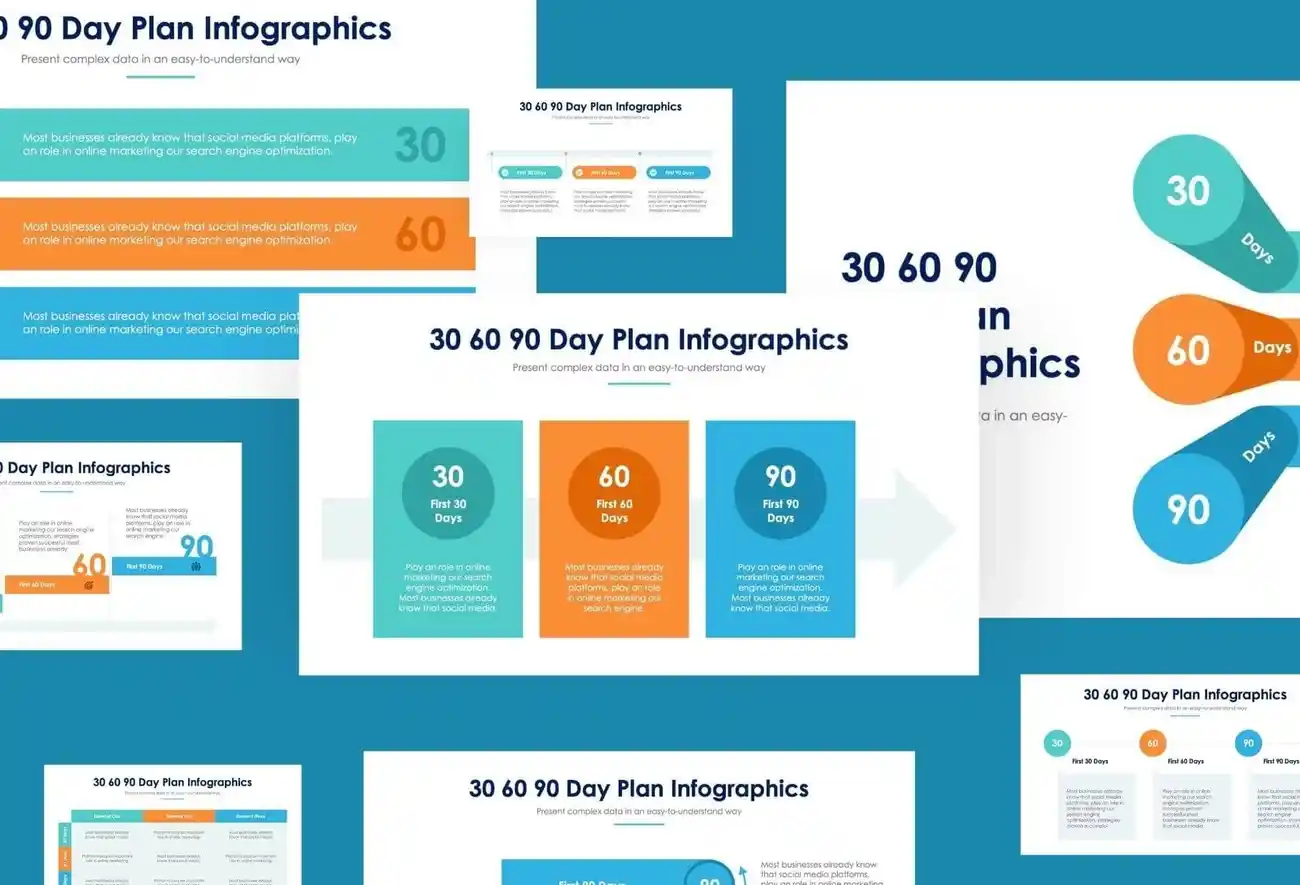
Image Source: Infografolio
Now that you have a validated business idea, the second week focuses on creating a roadmap for your success. This crucial planning phase will transform your idea into an actionable strategy.
Set clear 90-day goals and milestones
Breaking your first three months into manageable segments creates momentum and prevents overwhelm. Research shows businesses with clear goals than those without structured plans grow 30% faster. I recommend dividing your 90-day journey into three distinct phases:
- Days 1-30: Learning and foundation-building
- Days 31-60: Implementation and first customers
- Days 61-90: Refinement and scaling
For each phase, set 2-3 specific, measurable objectives. Moreover, schedule weekly check-ins to track your progress and adjust course as needed. This structured approach ensures you maintain focus while building flexibility into your plan.
Create a simple business plan
Your business plan serves as both a roadmap and a tool to convince potential partners or investors. Certainly, there’s no single “right” format – what matters is that it meets your specific needs.
Most entrepreneurs choose between two formats:
- Traditional business plans are comprehensive documents covering all business aspects, typically 15-25 pages long
- Lean startup plans summarize only essential elements on a single page and can be created in as little as one hour
Regardless of format, include sections on your business description, products/services, marketing strategy, operational plan, and financial projections. At Buz Business, we’ve found that even simple plans dramatically improve your chances of securing funding and growing sustainably.
Estimate your startup costs and budget
Understanding your expenses helps you launch successfully and avoid cash flow problems. Therefore, begin by listing all potential costs including registration fees, licenses, equipment, supplies, and marketing.
Once identified, categorize these expenses as either one-time costs (like permits or logo design) or monthly expenses (such as rent or salaries). This organization provides a clearer picture of your capital needs and when you’ll need it. Indeed, many entrepreneurs create a 12-month financial projection to ensure adequate funding throughout the critical first year.
Explore low investment business ideas in India
If your budget is tight, numerous profitable ventures require minimal capital. Popular options include dropshipping stores, virtual assistant services, content creation, and online tutoring.
For instance, selling branded merchandise through print-on-demand services lets you offer products without upfront inventory investment. Similarly, digital downloads like templates, e-books, or online courses provide excellent profit margins with near-zero production costs.
The key is selecting a business model that aligns with both your skills and your available resources. By the end of these two weeks, you’ll have a comprehensive plan that guides your business journey and sets you up for success in the implementation phase.
Step 3: Building Your Business (Days 16–45)
The implementation phase begins now! With your business idea validated and plan in place, it’s time to build the operational foundation of your enterprise.
Register your business and open a bank account
Once you start accepting or spending money as your business, opening a separate business bank account becomes essential. This critical step provides limited personal liability protection by keeping your business and personal finances separate. As a result, customers can make checks directly to your business rather than to you personally, enhancing your professional image.
To open an account, you’ll typically need your EIN (Employer Identification Number), formation documents, ownership agreements, and business license. Most banks offer perks that don’t come with personal accounts, including merchant services that allow you to accept credit card payments.
Set up your workspace or online presence
In today’s digital-centric world, an online presence isn’t optional – it’s necessary. Given that will search for a company’s website before visiting a physical location 76% of consumers, establishing your digital footprint is crucial.
Start by securing a domain name that represents your business. Next, create a professional website that makes your business look more credible while increasing visibility. Naturally, you should also establish social media accounts where your target audience spends time, as in the US use social media 82% of internet users.
Start creating your product or service
At Buz Business, we know this is where your idea transforms into reality. Begin developing your initial offering, whether it’s a physical product or service package. Of course, focus on creating something that solves the problem you identified in your research phase.
Use free tools to manage operations
Small businesses often have tight budgets, making free management tools invaluable. Google Docs provides cloud-based document collaboration, while HubSpot offers a powerful free CRM for managing customer relationships. At the same time, tools like Canva help with graphic design, and MailChimp supports email marketing for up to 500 subscribers.
Start marketing with zero or low budget
Even without marketing funds, you can still effectively promote your business. Consider these strategies:
- Content marketing: Create valuable blog posts and articles that position your brand as a thought leader
- Social media engagement: Build community through genuine interactions and consistent posting
- Referral programs: Get existing customers to promote your brand through structured word-of-mouth
- Local networking: Attend industry events and form partnerships with complementary businesses
Remember that the most powerful content is prescriptive and helpful, showing prospects how to do business better. Your goal is to make an impact with creative ideas rather than big spending.
Step 4: Launch and First Sales (Days 46–70)
It’s time to introduce your business to the world! Days 46-70 mark the exciting phase when you transition from building to launching your business and making your first sales.
Launch your business to a small audience
Initially, opt for a soft launch rather than a full-scale release. This approach lets you test your product with a limited audience before exposing it to the broader market. A soft launch helps identify issues, fine-tune your offering, and gradually build momentum. To begin with, select a small group from your target audience – they’ll become your first brand ambassadors when you expand later. This strategy is particularly effective if you’re operating with budget constraints, as it contributes to long-term financial savings.
Collect feedback and improve quickly
Feedback is fuel for your business growth. Promptly collect responses from your first customers through simple surveys, direct conversations, or digital tools. In essence, this input helps you spot problems before they show up in your metrics. For this purpose, focus on what customers loved, what could be improved, and whether the checkout process was smooth. Subsequently, use this information to refine your offering – remember that customers who engage are more likely to become paying customers in the future .
Use WhatsApp, Instagram, and local networks
WhatsApp is particularly powerful for businesses, with sent through the app daily more than 65 billion messages. Notably, it guarantees nearly 100% delivery rates and much higher open rates compared to other channels. Meanwhile, Instagram’s massive user base provides an excellent opportunity to showcase your products visually. Both platforms allow personalized communication that builds stronger customer relationships and boosts retention.
Offer discounts or free trials to attract first customers
People naturally love discounts – it’s almost human nature. Consider these strategies:
- Offer limited-time promotions to create urgency
- Provide free consultations or trial periods
- Send private offers to potential customers via WhatsApp
Free trials allow users to experience your product’s value firsthand, making them more likely to become paying customers. In fact, the average trial-to-paid conversion rate is 25%. At Buz Business, we’ve seen how effective these approaches can be for businesses starting with minimal investment.
Step 5: Scaling and Profitability (Days 71–90)
The final month of your 90-day journey focuses on establishing systems for sustainable growth. This critical phase transforms your fledgling business into a sustainable profit engine.
Track income, expenses, and customer feedback
Regular financial monitoring is vital for business health. Naturally, staying on top of your finances helps you identify trends, catch potential issues early, and make informed decisions about where to cut costs or invest. Tracking expenses improves cash flow, enables tax savings, and helps detect potential errors or fraud. Utilize tools that automatically categorize transactions to simplify this process.
Automate or outsource small tasks
Business process automation is booming, with the global market expected to reach USD 16.46 billion by 2026. Automate repetitive tasks like invoice generation, payment processing, and inventory management. AI-powered inventory systems can reduce out-of-stock instances by 35% while saving significant time on weekly stock checks. Outsourcing administrative tasks provides an additional layer of security by segregating important financial transactions through a certified third-party service provider.
Reinvest profits to grow
Strategic reinvestment fuels sustainable growth. Business experts recommend reinvesting 20-50% of profits back into your business. Key areas for reinvestment include:
- Building a better workforce through increased wages or enhanced benefits
- Technology upgrades to increase efficiency
- Marketing expansion to reach new customers
Build repeat customer base
Retained customers drive significant revenue—approximately 61% of small businesses state that repeat buyers generate over half their revenue. Even better, increasing customer retention rates by just 5% can boost profits by 25-95%. Collecting and acting on customer feedback creates a powerful loop that enhances loyalty. When customers feel their opinions matter, they’re more likely to return.
Plan for long-term sustainability
With years of hands-on experience, Buz Business offers expert guidance for creating sustainable businesses. Ultimately, comprehensive planning includes mechanisms for regular assessment and adaptation based on market trends and customer feedback. Business sustainability requires foresight—anticipating market fluctuations, shifts in consumer behavior, and evolving industry standards. Focus on building organizational resilience through strong leadership, clear communication, and a culture of accountability.
Conclusion
The 90-day journey from business idea to profitable enterprise might seem daunting at first glance. Nevertheless, breaking this process into manageable weekly tasks transforms an overwhelming challenge into achievable steps anyone can follow. Throughout this guide, we’ve shown how entrepreneurship has become more accessible than ever before, regardless of your prior business experience or available capital.
Remember that successful businesses start with identifying your existing skills and validating real market demand before investing significant time or money. Your early planning phase establishes the foundation for everything that follows. Subsequently, building your business infrastructure—whether digital or physical—prepares you for that crucial first customer interaction.
Many aspiring entrepreneurs never start because they believe they need substantial capital or perfect conditions. Contrary to this misconception, most small businesses can launch with just ₹1,000–₹20,000 and grow through strategic reinvestment of early profits. The digital economy has certainly created unprecedented opportunities for low-investment startups that can reach global audiences.
Feedback remains your most valuable resource during your entrepreneurial journey. Therefore, embrace customer input, adapt quickly, and continuously refine your offerings. This agile approach allows even new businesses to compete effectively against established players.
Buz Business understands the challenges you’ll face. After all, we’ve guided countless entrepreneurs through this exact process. The framework outlined here condenses years of hard-earned wisdom into a straightforward roadmap anyone can follow. Your entrepreneurial dreams are undoubtedly within reach—all it takes is 90 days of focused action to transform them into reality.
Are you ready to begin your business journey today?
FAQs:
Q1. How long does it typically take for a new business to become profitable?
While timelines can vary, many businesses aim to achieve profitability within 1-3 years. However, with proper planning and execution, it’s possible to generate profits more quickly. This guide outlines steps to potentially reach profitability in as little as 90 days for certain business models.
Q2. What are some low-cost business ideas to start with minimal investment?
Low-cost business ideas include dropshipping, virtual assistant services, content creation, and online tutoring. Many of these can be started with just a computer and internet connection. The key is choosing a model that aligns with your skills and available resources.
Q3. How important is it to have a business plan when starting out?
A business plan is crucial, even if it’s a simple one-page document. It serves as a roadmap for your business and can help you secure funding if needed. The plan should outline your business description, products/services, marketing strategy, operational plan, and financial projections.
Q4. What are effective ways to market a new business on a tight budget?
Cost-effective marketing strategies include content marketing through blogs and social media, building genuine engagement on social platforms, implementing referral programs, local networking, and using targeted online advertising like Google PPC within your budget constraints.
Q5. Should I try to do everything myself when starting a business?
While it’s tempting to handle everything yourself to save money, it’s often counterproductive. Focus on tasks only you can do and consider outsourcing or delegating other aspects. This allows you to concentrate on high-value activities that drive growth and prevents burnout.