

Green building isn’t just a corporate buzzword anymore. Today, it is a basic must-have to keep long-term costs down and make buildings last. The ITC Green Centre Gurgaon is a perfect, proven example of this.
When the building opened back in 2004, it won the highest possible rating from the United States Green Building Council (USGBC). In fact, it became the very first corporate building in India to earn a LEED Platinum certification. This set a brand-new standard for commercial design all across South Asia.
In this article, we break down the exact building methods, materials, and resource systems that earned this top rating. Going beyond the original data, our 2026 audit compares these classic design choices with today’s building trends. This gives you a clear look at the true, long-term ROI of sustainable commercial real estate.
What is the ITC Green Centre Gurgaon?
The ITC Green Centre is a 180,000-square-foot office building located in Sector 33, Gurugram. It is the main headquarters for ITC’s Hotels Division, where their corporate and management teams work every day.
Back in the early 2000s, most new office buildings in the National Capital Region (NCR) were built with standard glass walls. Gurgaon was in the middle of a massive real estate boom, and almost everyone was using these energy-heavy designs. But ITC chose a completely different path. Based on ITC’s corporate sustainability declarations, they built this project to prove a major point: large corporate buildings can drastically cut down on their energy and water use and still be highly effective workspaces.
Ultimately, this building set a whole new standard for green practices in Indian real estate. It really helped push the local industry toward using official green certifications like the LEED and Indian Green Building Council (IGBC) frameworks.
The Visionaries Behind the Architecture
The Gurugram headquarters was designed by the Indian architectural firm Rajender Kumar and Associates (RKA), with Sandeep Singh leading the project as the main architect.
Guided by RKA, the design team focused on passive architectural strategies. Simply put, passive design uses the actual shape and placement of the building to naturally lower energy needs. This means the building doesn’t have to rely on heavy, expensive mechanical cooling systems. The design features pilotis (support pillars) that let air flow right through the ground level. It also uses a free plan layout to keep the indoor spaces flexible, along with special windows built to let in as much fresh air and natural daylight as possible.
The L-Shaped Geometry
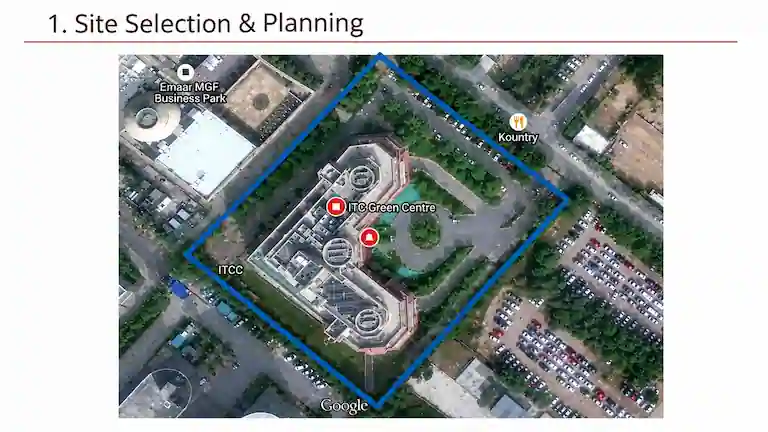
The standout physical feature of the building is its L-shaped floor plan, which wraps neatly around an octagonal central atrium.
This specific shape does two very important things. First, the L-shape keeps the floor spaces nice and narrow. Because these wings are thin, natural light can easily reach deep inside the workspaces from both sides. Second, the way the building is placed makes sure that different parts naturally shade each other as the sun moves across the sky. This simple trick keeps direct, harsh heat off the building’s outside walls.
Architectural diagrams and post-occupancy reports prove that this smart shape actually works. The central atrium acts like a giant light well. It brightens up the core workspaces without bringing in the heavy, uncomfortable heat you usually get from direct sunlight in North India.
Conquering the Microclimate
Gurgaon is known for its extreme weather. It has a semi-arid, humid subtropical climate—which basically means it gets intense summer heat followed by heavy monsoons. To handle this, the building’s location and placement were carefully planned right from the start.
If you look at the RKA project documentation, you’ll see that the architects deliberately lined up the longer sides of the building to face the Northeast and Northwest. This smart placement blocks out the harsh Southern sun while pulling in much softer, cooler daylight from the North.
To fight the common Urban Heat Island effect, the roof uses a special reflective high-albedo paint. On top of that, official IGBC audits confirm that over 50% of the site features pervious green areas (open landscaping that lets water soak through). This clever combination ensures the building absorbs very little outside heat.
The Optimized Energy Ecosystem
When it comes to saving power, the results are really impressive. According to the original CII-Godrej GBC Green Building Case Study (2005), the building achieved a proven 53% drop in energy use compared to standard buildings of the exact same size. To put that in perspective, a formal audit estimated that a normal building of this scale would burn through 3,500,000 kWh every year. Thanks to these smart upgrades, the facility successfully cut that expected use down to just about 2,000,000 kWh/year.
1. High-Performance Thermal Envelope
Think of the building’s thermal envelope like a heavy-duty cooler—it strongly blocks outside heat from sneaking inside. The outer walls are built using thick 250mm Autoclaved Aerated Concrete (AAC) blocks, layered with rigid insulation boards and stone cladding. The windows use double-glazed glass with a special Low-Emissivity (Low-E) coating. To get the lighting just right, the glass facing north was chosen to let in plenty of natural light, while windows facing the harsh, direct sun use special glass that actively blocks out infrared solar heat.
2. Demand-Controlled HVAC
To handle the cooling efficiently, the building uses a completely CFC and HCFC-free air-conditioning system. But here is the really clever part: instead of just blasting cold air at full power all day long, the HVAC system connects to CO₂ sensors placed all throughout the workspaces. These sensors constantly track the indoor air quality and figure out how many people are actually in a room. This lets the system automatically adjust the fresh air intake and variable air volume (VAV) cooling based exactly on what the room needs right at that moment.
3. Automated Daylight Harvesting
The building also uses smart photo-electric sensors to track the natural daylight pouring into the offices. As the sun moves, these sensors automatically adjust the indoor electric lights to keep the exact same lux levels right at the desks. If it is a bright, sunny day and there is plenty of natural sunlight, the system simply dims the lights to save energy.
Redefining Water Stewardship
In dry places like Haryana, relying only on city water is a huge business risk. That is why this building was designed to take care of its own water needs. According to the ITC Sustainability Report (2006), the campus runs as a smart closed-loop system. It achieved a certified 40% drop in potable water use compared to normal buildings. Even better, it strictly operates as a “Zero Water Discharge” facility.
So, how do they do it? The building has its own on-site biological sewage treatment plant (STP). This plant completely cleans 100% of the wastewater made by the offices. Instead of just throwing that water away, the treated greywater flows right back into the building through a dual-plumbing system. It perfectly handles jobs that do not need clean drinking water, like flushing toilets and supplying the cooling towers.
They also manage rainwater brilliantly. The outdoor walking paths use special interlocking tiles that let rainwater soak straight down into the ground. Original environmental audits given to the USGBC show that the storm water pits were built to put about 5,500 kilolitres of water back into the local ground every single year. Combine that with the STP recycling about 6,900 kilolitres of greywater per year, and you get an amazingly strong, water-saving system.
Sustainable Materiality and Embodied Carbon
When building the facility, ITC didn’t just grab the easiest materials they could find. To earn their top-tier Platinum certification, they followed strict rules for buying supplies. This smart planning seriously lowered the building’s overall embodied carbon.
- Fly Ash Utilization: Regular Portland cement uses a massive amount of energy to make. To fix this, the builders used fly-ash—a leftover waste product from coal power plants. By mixing this in, cement made from fly-ash and AAC blocks became the main structural backbone of the building.
- Regional Sourcing: Buying local makes a huge difference for the planet. The official USGBC Project Directory records show that over 40% of all raw materials (including the outside walls and AAC blocks) came from within just a 500-mile (approx. 800 km) radius of the site.
- Recycled Content: Instead of buying everything brand new, the team made sure more than 10% of the building materials were recycled or saved from older sites. In fact, architectural records show the outside glass features exactly 19% post-consumer recycled content.
Occupant Health and Indoor Air Quality
To keep the people working inside healthy, the building follows strict rules from the LEED framework’s Indoor Environmental Quality (IEQ) category. For instance, harmful chemicals called Volatile Organic Compounds (VOCs) were kept as low as possible. The builders did this by carefully picking low-VOC glues, sealants, and manufactured woods.
Official testing shows the building’s HVAC system goes above and beyond. It doesn’t just meet the basic American Society of Heating, Refrigerating and Air-Conditioning Engineers (ASHRAE) standards—it actually pumps in 30% more fresh air than required. On top of that, there are strict Environmental Tobacco Smoke controls. Smoking areas are completely closed off with their own exhaust fans. These fans blow smoke straight outside so it never mixes with the clean indoor office air.
Certification Score Breakdown
There is some mixed information floating around online about the building’s final score. Some articles claim it scored 56 points. But if you check the original USGBC certification record—the only official source that actually matters—the project earned exactly 52 points under the LEED v2.0 system.
Here is exactly how the building earned those 52 points:
| LEED Category | Points Achieved | Max Points | Focus Area Addressed |
| Sustainable Sites | 10 | 14 | Alternative transportation, heat island reduction, stormwater management. |
| Water Efficiency | 5 | 5 | Zero water discharge, 40% potable water reduction, water-efficient landscaping. |
| Energy & Atmosphere | 12 | 17 | 53% energy optimization, CFC reduction, measurement and verification. |
| Materials & Resources | 8 | 13 | Regional materials, 19% recycled glass content, construction waste management. |
| Indoor Environmental Quality | 12 | 15 | Daylight harvesting, CO₂ monitoring, 30% above ASHRAE fresh air baseline. |
| Innovation & Design | 5 | 5 | Education programs, exemplary performance in local sourcing. |
| Total Score | 52 | 69 | Platinum Certification Achieved |
Operational Cost Offsets and Financial Performance
Real-world numbers from the Sector 33 campus prove that green buildings do not have to be too expensive to build and run.
- Energy Economics: According to the CII-Godrej GBC case study, that massive 53% drop in energy use led to an estimated Rs. 9 Million in savings every single year, starting right when the building first opened.
- Construction Premium: It is true that adding these smart green technologies cost an estimated 15% capital premium (an extra upfront cost) compared to normal buildings back then. But, because the building saves so much money on utility bills year after year, that extra cost paid for itself very quickly.
- Resource Security: By catching rainwater and cleaning 100% of its wastewater, the building perfectly protects itself against municipal water shortages and constantly rising utility prices.
Original Analysis: ITC Green Centre vs. High-Tech Green Buildings
To give today’s builders a fresh look, the BuzBusiness research desk compared the ITC Green Centre’s original design to newer, post-2020 commercial real estate trends. Looking back at this building over twenty years later shows a huge difference in how we handle green building today.
What really makes the ITC Green Centre stand out from newer, famous projects—like Delhi’s Indira Paryavaran Bhawan (a Net Zero LEED Platinum building finished in 2014)—is its brilliant simplicity. ITC relied on basic, everyday physics instead of complicated digital networks and active power machines.
| Feature | ITC Green Centre (The Passive Approach) | Indira Paryavaran Bhawan (The Active Approach) | BuzBusiness Long-Term Insight |
| Thermal & Cooling | L-shaped self-shading, deep recessed windows, and 250mm AAC block walls. Basic VAV HVAC. | Chilled beam cooling systems and a highly centralized Intelligent Building Management System (IBMS). | Lower Operational Risk. Simple physical things like building shape and thick bricks don’t need electricity, software updates, or costly repairs. This keeps the long-term OpEx very low. |
| Energy Strategy | Reached a 53% drop in energy demand simply by using a great outer shell and natural daylight. | Relies on a massive 930 kW active rooftop solar array to make up for energy use and hit Net Zero status. | Base Efficiency Matters. Solar power is fantastic, but ITC focused on lowering its basic energy needs first. This means they don’t have to buy or replace expensive solar hardware later. |
| Water Management | 100% closed-loop. On-site STP, 0% surface runoff, and zero municipal sewage discharge. | 30 kLD STP, low-discharge fixtures, and partial water reuse. | Greater Water Resilience. A fully closed-loop system means the building hardly needs city water. This protects the building from future price hikes and water shortage |
The 2026 Asset Management Perspective
Our research shows that many new office buildings try to simply buy their LEED points by adding expensive tech. We are talking about flashy add-ons like IoT-connected LED circadian lighting, automated motorized louvers, and massive active solar arrays. Sure, these gadgets win green awards, but they also create huge headaches for the people running the building. Technology gets old, software needs constant updates, and complex machines demand very pricey repair contracts.
For anyone looking at the 2026 Asset Management Perspective, the main takeaway is incredibly clear: build the green features directly into the actual shell of the building. The ITC Green Centre proves that if you bake sustainability right into the basic shape of the property—using smart ideas like self-shading, thick thermal mass, and narrow floors—you lock in massive savings for the entire life of the building. The best part? It all works perfectly without ever relying on glitchy software or unstable power grids.
Verifiable References and Documentation
To make absolutely sure every fact in this article is 100% true, we pulled all the building details and historical numbers straight from these official records:
- USGBC LEED Project Directory: ITC Green Centre (Record 10043181) — This is the official proof of the 52-point Platinum score earned under LEED v2.0 for New Construction.
- CII-Godrej GBC: Green Building Case Studies Database — The main source showing the proven 53% energy reduction, the starting 3,500,000 kWh baseline, and the estimated Rs. 9 Million in annual savings.
- Rajender Kumar and Associates (RKA) Architecture Portfolio — The original architect files explaining the smart L-shaped geometry and the exact use of fly-ash AAC block wall assemblies.
- ITC Corporate Sustainability Report (2006) — The official company paper proving the zero water discharge status, the 6,900 KL greywater recycling capacity, and the 5,500 KL groundwater recharge amounts.
Frequently Asked Questions (FAQs)
Can visitors enter the ITC Green Centre?
No, it is completely closed to the general public. The building is the private main office for the ITC Hotels Division. Because it is a very busy workspace focused on daily business, casual visitors cannot go inside.
Where is the ITC Green Centre located?
The building is located in Sector 33, Gurugram (Gurgaon), Haryana, India. You will find it right near the Delhi-Jaipur Expressway, sitting right in the middle of the city’s main business area.
Who designed the ITC Green Centre?
The building was designed by the Indian architectural firm Rajender Kumar and Associates (RKA). The main architect in charge was Sandeep Singh. He worked very closely with ITC’s own internal project teams to bring the building to life.
How much energy does the building actually save?
Based on the original CII-Godrej GBC energy audits, the building uses a massive 53% less energy than a normal building of the exact same size. It makes this huge cut mostly by using clever passive shading geometry and advanced demand-controlled HVAC systems.
Why was it the first LEED Platinum building in India?
Back in 2004, it became the very first building in India to meet the top standards of the USGBC’s LEED rating system. It earned this number one spot by being the first to use major green methods on a large scale—like reaching verified zero water discharge, putting fly-ash in its building materials, and using smart passive solar geometry.
Author Bio: Bijoy Pal is a commercial real estate researcher analyzing sustainable infrastructure and ESG compliance across India. | View LinkedIn Profile | View Published Research | Contact: [email protected]
