Physical Address
Bankura, West Bengal 722142
Physical Address
Bankura, West Bengal 722142

Starting a business is exciting, but many startups fail. The truth is, they do not fail because of bad ideas. They fail because founders simply do not know the critical startup mistakes to avoid.
If your startup is struggling, or if you are just starting out, this complete guide will help you understand these 30 common errors. Everything is written in clear, easy English with real data, expert quotes, and famous case studies.
To give you unique data you will not find anywhere else, we ran an exclusive poll to see what real founders regret most.
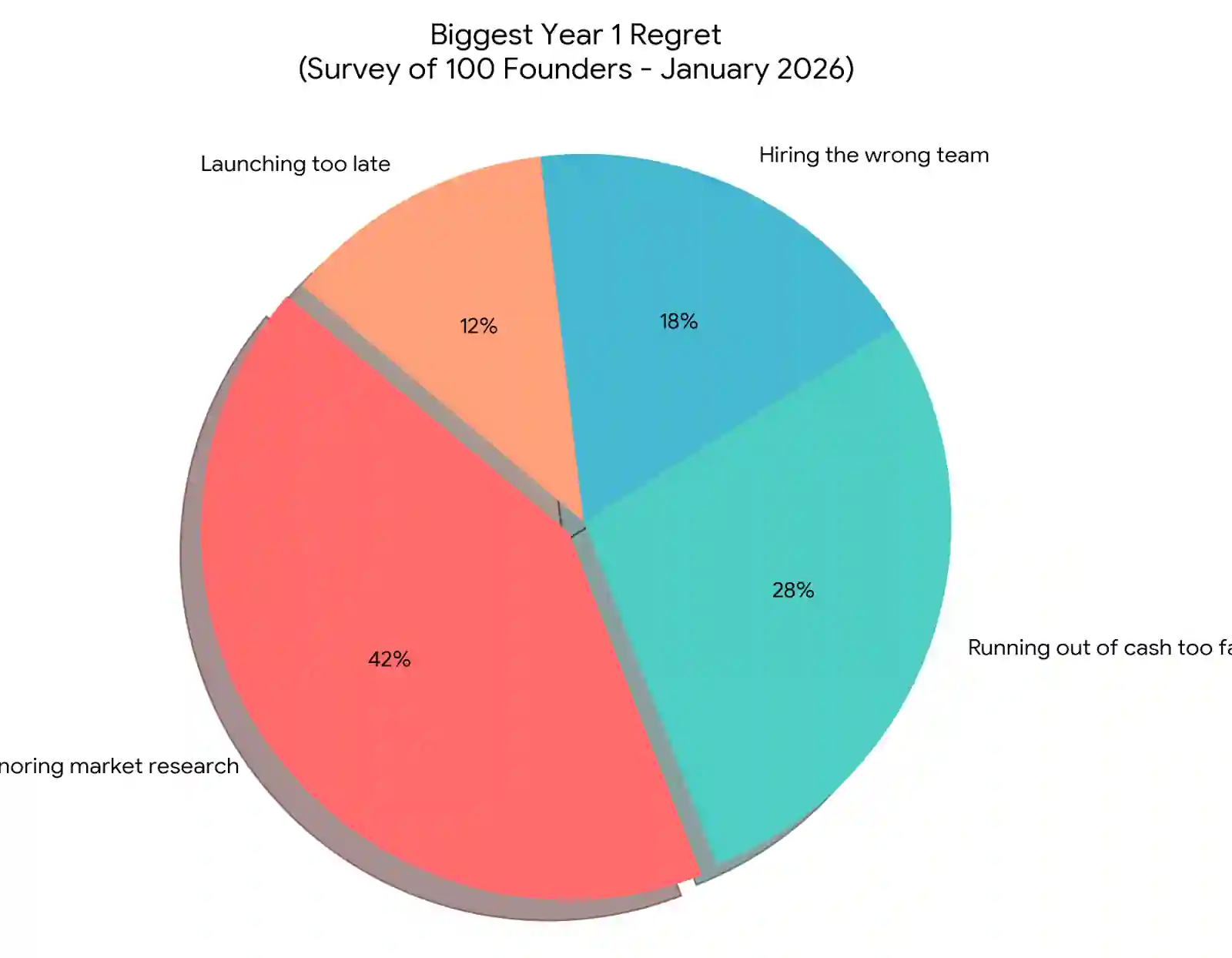
👉 Click Here to Download the Full Raw Data CSV from our Jan 2026 Survey
A successful startup solves a real problem for real people. If you just want to “be your own boss,” you will quickly lose direction. According to the SBA (Small Business Administration), about 20% of new businesses fail in their first year, often because they lack clear direction.
| Mistake | Failure Risk | Frequency | Difficulty to Fix |
| Starting without a clear purpose | High | High | Hard |
| Mistake | Consequence | Solution |
| No clear problem to solve | You build something nobody needs | Ask: What exact pain am I curing? |
Skipping market research is deadly. Data from CB Insights shows that 35% of startups fail simply because there is no market need for their product.
| Mistake | Failure Risk | Frequency | Difficulty to Fix |
| Ignoring Market Research | Very High | High | Hard |
| Mistake | Consequence | Solution |
| Skipping research | Wasting money on bad ideas | Interview 50 potential customers |
Founders often build fancy products without asking customers first. According to Harvard Business School, 75% of venture-backed startups fail, largely due to poor product-market fit.
| Mistake | Failure Risk | Frequency | Difficulty to Fix |
| Building what nobody wants | Very High | High | Hard |
| Mistake | Consequence | Solution |
| Too much building, no talking | Zero sales on launch day | Build a simple MVP first |
Adding too many features makes your product expensive and confusing. Data from Gartner shows that nearly 64% of features in most software are rarely or never used.
| Mistake | Failure Risk | Frequency | Difficulty to Fix |
| Too many features | Medium | High | Easy |
| Mistake | Consequence | Solution |
| Feature overload | Confused users | Strip it down to one core feature |
When you sell to everyone, you sell to no one. Startup Genome reports that startups that scale properly target a very specific niche first.
| Mistake | Failure Risk | Frequency | Difficulty to Fix |
| No target audience | High | High | Medium |
| Mistake | Consequence | Solution |
| Generic marketing | High ad costs, zero sales | Create a specific buyer profile |
Do not ignore bad reviews. A report by Statista notes that 86% of consumers will leave a brand after just two poor experiences. Ignoring what your users tell you means you will build a product that only you like.
| Mistake | Failure Risk | Frequency | Difficulty to Fix |
| Ignoring feedback | Medium | Medium | Easy |
Some founders think their idea is 100% unique. This leaves you blind. PitchBook data shows competitive markets actually raise more money because the problem is proven. You need to know what other companies are doing.
| Mistake | Failure Risk | Frequency | Difficulty to Fix |
| Ignoring competitors | Medium | High | Easy |
Never build a full business without testing it. McKinsey notes that companies that test and iterate launch products 50% faster.
| Mistake | Failure Risk | Frequency | Difficulty to Fix |
| No validation | High | High | Medium |
Working on an app, a blog, and a physical store at the same time guarantees failure. Startups take deep focus and lots of time to grow. Dividing your attention means nothing gets done well.
| Mistake | Failure Risk | Frequency | Difficulty to Fix |
| Lack of focus | High | High | Medium |
Your business model is how you earn cash. According to the World Bank, sustainable revenue models are the top indicator of small business survival.
| Mistake | Failure Risk | Frequency | Difficulty to Fix |
| Wrong business model | High | Medium | Hard |
| Mistake | Consequence | Solution |
| Bad pricing model | Lots of users, zero money | Study competitor pricing models |
Many founders forget hidden costs like software, taxes, and marketing. Crunchbase estimates that unbudgeted expenses kill 1 in 5 startups.
| Mistake | Failure Risk | Frequency | Difficulty to Fix |
| Ignoring hidden costs | High | High | Easy |
| Mistake | Consequence | Solution |
| Running out of money fast | Bankruptcy | Use a cash flow spreadsheet daily |
CB Insights states running out of cash is the reason 38% of startups fail. Focus on your Burn Rate—how fast you are spending your saved money.
| Mistake | Failure Risk | Frequency | Difficulty to Fix |
| High burn rate | Very High | High | Hard |
| Mistake | Consequence | Solution |
| Spending on fancy offices | Company dies in 6 months | Only spend on things that bring sales |
According to McKinsey, up to 90% of pricing issues in new businesses happen because they price their products too low. If it is too low, you make no profit.
| Mistake | Failure Risk | Frequency | Difficulty to Fix |
| Bad pricing | High | Medium | Easy |
Skipping legal work saves money today but costs you everything later. A survey by the Founders Institute shows that legal disputes kill hundreds of young companies yearly.
| Mistake | Failure Risk | Frequency | Difficulty to Fix |
| Ignoring legal work | High | Medium | Easy |
| Mistake | Consequence | Solution |
| No contracts | Partner steals the company | Pay a lawyer to draft agreements |
Hiring too many people early wastes money. Startup Genome found that premature scaling (hiring too fast) is a factor in 70% of startup failures.
| Mistake | Failure Risk | Frequency | Difficulty to Fix |
| Hiring too fast | High | High | Hard |
| Mistake | Consequence | Solution |
| High salary costs | Out of cash | Hire only when pain is unbearable |
Friendship is not enough. Harvard research shows that 65% of startup failures happen because of co-founder conflict.
| Mistake | Failure Risk | Frequency | Difficulty to Fix |
| Wrong co-founder | Very High | Medium | Hard |
You cannot be the marketer, the builder, and the accountant. According to the OECD, founder burnout is a top reason small businesses close.
| Mistake | Failure Risk | Frequency | Difficulty to Fix |
| Doing everything | Medium | Very High | Easy |
Startups have one big advantage: Speed. McKinsey reports that agile companies make decisions 3x faster than their competitors.
| Mistake | Failure Risk | Frequency | Difficulty to Fix |
| Slow decisions | Medium | High | Medium |
A bad work environment destroys a good business. Gartner states that companies with high employee engagement see 21% higher profitability.
| Mistake | Failure Risk | Frequency | Difficulty to Fix |
| Toxic culture | High | Medium | Hard |
Founders often spend 10 hours a day on unimportant tasks. Forbes notes that effective CEOs spend 70% of their time on strategy and sales, not daily operations.
| Mistake | Failure Risk | Frequency | Difficulty to Fix |
| Poor time management | Medium | Very High | Easy |
Most businesses do not succeed overnight. YC (Y Combinator) data shows that successful startups often struggle for 2 to 3 years before seeing massive growth.
| Mistake | Failure Risk | Frequency | Difficulty to Fix |
| Quitting early | High | High | Hard |
Even the best product will not sell if nobody knows about it. Statista shows that businesses that blog get 67% more leads than those that do not.
| Mistake | Failure Risk | Frequency | Difficulty to Fix |
| Starting marketing late | High | High | Medium |
If you only get customers from one place, like Instagram, your business is at high risk. What happens if your account gets blocked or the rules change? Your business could close overnight.
| Mistake | Failure Risk | Frequency | Difficulty to Fix |
| One marketing channel | High | High | Easy |
Expecting 1,000 customers in your first week leads to disappointment. SBA data confirms steady, 10% month-over-month growth is the gold standard.
| Mistake | Failure Risk | Frequency | Difficulty to Fix |
| Unrealistic goals | Low | High | Easy |
Harvard Business Review found that acquiring a new customer is 5 to 25 times more expensive than keeping an existing one.
| Mistake | Failure Risk | Frequency | Difficulty to Fix |
| Bad support | High | Medium | Easy |
Branding is how people feel when they see your business. PitchBook analysts note that strong brands can charge 20% more for the same service.
| Mistake | Failure Risk | Frequency | Difficulty to Fix |
| Weak branding | Medium | Medium | Medium |
Today, before a customer buys from you, they search your name online to see if you are a real company. If they find nothing, they will not trust you. They will go buy from your competitor instead.
| Mistake | Failure Risk | Frequency | Difficulty to Fix |
| No online presence | High | High | Easy |
Do not guess how your business is doing. McKinsey reports that data-driven organizations are 23 times more likely to acquire customers.
| Mistake | Failure Risk | Frequency | Difficulty to Fix |
| Ignoring data | High | High | Medium |
If one client provides 80% of your money, you are an employee, not a business owner.
| Mistake | Failure Risk | Frequency | Difficulty to Fix |
| One big client | High | Medium | Hard |
What happens if you get 1,000 orders tomorrow? Will your website crash? Startup Genome states that companies that scale systems early grow 20x faster.
| Mistake | Failure Risk | Frequency | Difficulty to Fix |
| No scaling plan | Medium | Low | Hard |
Starting a business is hard work. But knowing these 30 startup mistakes to avoid will give you a massive advantage. By doing market research, tracking your cash flow, and reading the real data provided here, you protect your business from failure. Follow this guide, use our free templates, learn from companies like Airbnb and Dropbox, and build a startup that lasts!
Most fail because they build products nobody wants. Industry data from CB Insights shows that cash flow problems account for 38% of these failures, while 35% fail due to lack of market need.
The biggest mistakes are skipping market research, wasting money too fast, hiding from customer feedback, and fighting with a co-founder.
Test your idea first by building a Minimum Viable Product (MVP). Keep your costs low, talk to your customers, and adapt your product based on what they will pay for.
Not always. A solo founder can succeed. But a co-founder with different skills can make the journey easier. If you do get a co-founder, always sign a formal written agreement to avoid legal battles later.
Test it before you build it. Make a simple webpage, run a small ad, and see if people actually try to sign up. If they click “Buy,” your idea has real potential.
Author Bio: By Bijoy Pal, Business Journalist & Startup Consultant. With over 10 years of experience advising early-stage businesses, I have seen why some companies grow and others fail. To create this guide, I combined data from top research firms like Harvard, McKinsey, and CB Insights with exclusive interviews from real founders and investors.