Physical Address
Bankura, West Bengal 722142
Physical Address
Bankura, West Bengal 722142


Lal Kakra Beach is a very quiet spot in a village called Dakshin Purushottompur, right next to Mandarmani. It is famous for thousands of red crabs and a wild, natural shore that most tourists never see. Because it is hidden, it is one of the least crowded beaches in West Bengal and a perfect weekend getaway from Kolkata.
Digha feels like a busy market, and Mandarmani can feel like a noisy party. If you want true peace—where you only hear the waves—you should go to Lal Kakra. Trees hide the beach, making it feel wild. You won’t find giant hotels here.
I stayed here for a full week to see if the viral videos were real. I wanted to know: does the sand really turn deep red, or is it a camera trick? This guide gives you the truth so you can see the “Red Wave” yourself on a budget.
| Feature | Details |
| Distance from Kolkata | ~165 km (4.5 hours by car) – Great weekend getaway from Kolkata |
| Best Time to Visit | October to February |
| Winter Temperature | 12°C to 25°C (Perfect for outdoor walks) |
| Nearest Railway Station | Kanthi (Contai) Station |
| Mobile Network | Airtel and BSNL work best; Jio is weak |
You will find Lal Kakra Beach in Dakshin Purushottompur village, near Mandarmani in West Bengal. It sits close to where the Pichaboni River meets the sea. This mix of river and sea water is exactly why so many red crabs live here.
If you want to explore more later, this location is great. It is only about 15 km away from Tajpur Beach, a short drive to Udaipur Beach, and close to other offbeat coastal spots like Bankiput Sea Beach. Do not just type “Mandarmani” into your maps, or you might miss the turn. The drive from Contai is short, and the last part is a beautiful ride through green village fields.
Lal Kakra Beach is not a busy town. It is a wild, 2-kilometer stretch of nature. It sits between the expensive hotels of Mandarmani and the quiet forests of Baguran Jalpai.
The biggest mistake people make is thinking this place is “just like Digha.” It is not. You will not find paved walking paths, fast food stalls, or bright street lights here. If you visit during high tide, you will see nothing but empty sand. To see the famous red crabs, you need to know a few secrets.
Many travel blogs say red crabs are “everywhere.” That is false. In Mandarmani, loud ATVs and cars have scared the crabs away. At Lal Kakra, the crabs still own the beach, but you must know how to find them.
These crabs are actually called Red Ghost Crabs (Ocypode macrocera). The Pichaboni River Estuary provides a perfect, nutrient-rich mix of river and seawater. This wet sand is full of microscopic food (like plankton) that the crabs filter and eat. Why did they disappear from Mandarmani and Digha? Heavy tourist cars drove on the beach, which pressed the sand down (soil compaction) and crushed their burrows. Pollution also pushed them away. Lal Kakra is a fragile ecosystem, and we must protect it.
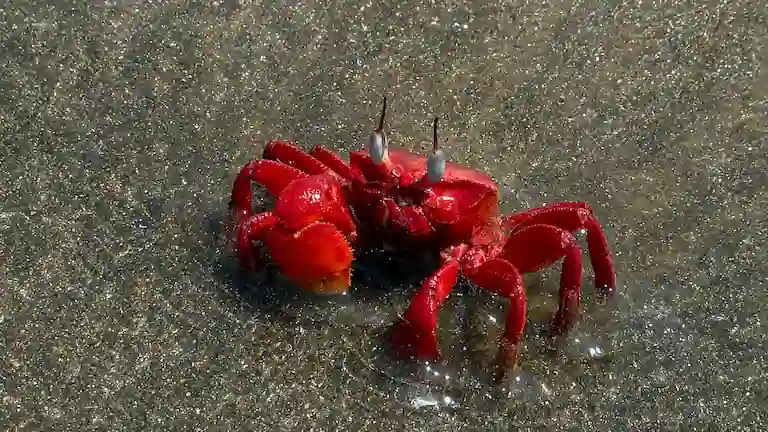
Red crabs are not afraid of humans; they are afraid of footsteps. They feel the ground shaking from 30 feet away. If you run toward them, they will hide in their holes in one second.
The Secret: Walk toward the Pichaboni River Estuary at the north end of the beach. Sit down and stay completely still. In 10 minutes, thousands of crabs will come out. The sand will look like a moving red carpet.
To see the crabs, you must check the local tide timings.
The Best Time: The crabs come out about 2 hours after the high tide starts to go back out into the sea.
The Science: Remember, low tide shifts by roughly 50 minutes every day. You cannot rely on yesterday’s time. Instead of guessing, check a reliable coastal tide website like Tide-Forecast.com (search for Mandarmani) before you step out of your room. Be on the beach between 6:30 AM and 9:00 AM. By noon, the sand is too hot, and the crabs hide.
The main entrance can get a little busy on weekends. For total quiet, walk 1.5 km North toward the river. The sand is softer, the trees are thicker, and the crab groups are much larger because cars cannot reach there.
Navigation Tip: If you want to walk exactly to the best crab-watching spot near the estuary, use these precise GPS coordinates on Google Maps: 21°40’00.0″N 87°44’25.0″E. This will guide you straight to the quiet zone.
Many people visit just to take photos, but it is hard because the crabs are fast and get scared easily.
If you want to see the red crabs, the best time to visit is between October and February. Winter is perfect because the temperature stays between a very comfortable 12°C to 25°C. The sand does not get too hot, so the crabs stay out much longer.
Timing is everything. Summer is too hot, and the crabs hide by 10:00 AM. Also, try to skip big public holidays. The crabs are shy; if too many people are walking around, they will not come out. A quiet Tuesday or Wednesday morning is the absolute best time.
Getting here takes a little effort, but that keeps the big crowds away. Here is exactly how to reach the beach cheaply and easily.
You do not need to go all the way to Digha. It wastes time.
You can take any Digha-bound SBSTC or private bus from Esplanade or Howrah in Kolkata.
Whether you get down at Kanthi Station or Chowlkhola, drivers will try to overcharge you. If you say you are going to a “Mandarmani Resort,” they will ask for ₹500. Here is the exact script to use:
“I am going straight to the Vivekananda Math in Dakshin Purushottompur. I know the local rate is ₹300.”
Be polite but firm. A private Toto ride should only cost you ₹300 to ₹350.
You will not find 5-star glass hotels directly on this beach. The government banned big hotels to protect the nature here. This means your stay options are simple, peaceful, and unique.
If you want deep peace, this is the best spot.
Often referred to locally as the Red Crab Beach Camp, this is the best choice if you want to be close to nature but sleep in a good bed.
Because Lal Kakra is a small, natural spot, a one-night trip is perfect. Here is exactly how to spend your time to get the best experience without rushing.
After arriving via Kanthi Station (using the ₹300 Toto ride) or driving 4.5 hours from Kolkata, check into your beach camp or the Ramkrishna Math. Enjoy a simple, traditional Bhog Prasad or a fresh local seafood lunch.
Take a walk toward the Pichaboni River Estuary. You will not see a direct ocean sunset here because of the way the beach faces, but the twilight colors reflecting on the wet sand are absolutely beautiful for photography.
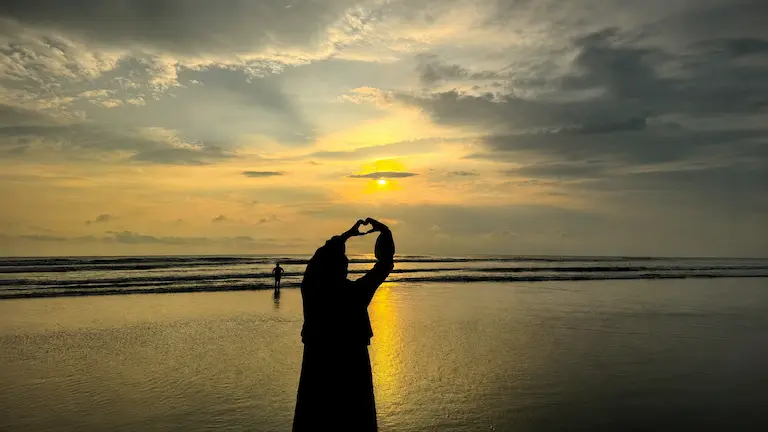
This is your Golden Window. Wake up early and head to the beach about two hours after high tide. Stand completely still so you do not break the “Vibration Rule,” and watch millions of red crabs come out of the sand.
By mid-morning, the sun makes the sand too hot, and the crabs go back into their holes. Go back to your room, eat breakfast, pack your bags, and catch a Toto back to Chowlkhola or Kanthi Station for your journey home.
If you are deciding where to go this Friday, here is a simple and honest comparison:
| Feature | Lal Kakra Beach | Mandarmani | Digha |
| Red Crabs | Massive numbers – they own the beach | Very few – scared away by cars | Almost none – too crowded |
| Noise Level | Peaceful – just waves & birds | Loud – ATVs, music, big hotels | Very noisy – busy streets |
| Sand Type | Soft, wild, and natural | Hard-packed, cars drive on it | Mostly concrete walls |
| Best For | Peace, couples, nature photos | Big groups, parties, water sports | Budget trips, shopping |
| Crowds | Very low – even on weekends | High – resort crowd | Extremely high – all year |
Because this is a wild area, you need to be prepared. Before you pack your bags, read these essential rules.
The local village shops only sell basic items. Clean, packaged drinking water can be hard to find in the camps. It is best to buy large bottles of mineral water from a highway shop at Chowlkhola before you reach the village, especially if you are traveling with kids.
You cannot just walk out of your tent at 9:00 PM and expect to find an open restaurant. There are none. You must tell the camp caretaker exactly what you want to eat for dinner by the early afternoon. If you do not pre-order, you will not get food.
The Pichaboni estuary creates mixing waters and hidden, strong undercurrents. It is not safe for swimming. Enjoy walking on the wet sand and watching the crabs, but do not go deep into the water.
The water rises very quickly near the estuary. When the high tide comes in, the water level changes fast. Be very careful and do not walk out onto empty sandbars in the river, or you could easily get stranded and trapped by the rising water.
Power cuts happen in this village. Camps use generators, but usually only at night. More importantly, there are virtually no wall plugs inside the basic tents. You will not be able to simply plug in your phone charger while you sleep. You must bring a fully charged, high-capacity power bank.
Since the beach is right next to a river and a thick forest, mosquitoes come out heavily in the evening. Always carry a strong mosquito repellent cream or spray to protect yourself at night.
Jio is very weak near the beach. Airtel and BSNL are your best choices here.
The beach is very safe, but there are zero street lights. It gets pitch black at night. Carry a strong torch (flashlight) if you walk around after sunset so you do not get lost in the trees.
This is a protected nature area. Never throw plastic on the sand. Do not try to catch the crabs; the stress can kill them.
As this is a remote village, it is always smart to have local emergency numbers saved on your phone:
If you want luxury, go to Mandarmani. If you want to shop, go to Digha. But if you want to see the coast of Bengal exactly as it was 50 years ago—wild, quiet, and beautiful—Lal Kakra is the best choice left.
Ready for more travel inspiration? Once you finish your beach trip, check out my Mirik Tourism Guide for a peaceful mountain escape.
Please do not. The sand here is very soft, and your car will get stuck. Also, driving on the sand crushes the crab homes. Park at your camp and walk.
Yes, but summer is hard. It gets too hot, and crabs hide by 10:00 AM. October to February is much better because the weather is cool and the crabs stay out longer.
Yes, it is very safe. The village is quiet, and the local people are helpful. The only issue is the dark—there are no street lights at night. If you travel alone, booking a room at the gated Vivekananda Math feels very safe and secure.
About the Author: Bijoy Pal is a digital content publisher and the website operator at buzbusiness.com. With a deep passion for finding hidden destinations, Bijoy spends weeks on the ground—like living at Lal Kakra Beach to study the local tide tables and transit costs—to ensure every travel guide is fact-checked, accurate, and genuinely helpful for travelers. Connect with Bijoy to explore more verified West Bengal tourism guides.